Dev Update: The First “Unit World” of Jumpy vs. Chompy 2 Is Complete

Hu Ping
6d ago
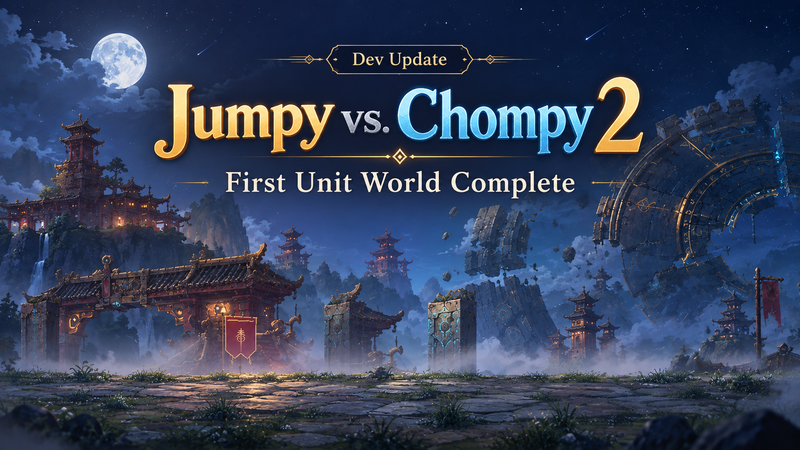
# Dev Update: Our First “Unit World” Is Now Complete
Development on **Jumpy vs. Chompy 2** has reached an important milestone.
For a long time, I was experimenting with how the horizontal world should work.
Should it loop forever?
Should it simply become a very long stage?
Should every dungeon exist as an isolated level?
After many iterations, I finally found the structure I want.
## A World Is No Longer Just One Map
The first major area of Jumpy vs. Chompy 2 is now designed as a **finite Unit World**.
Instead of endlessly repeating scenery, the main horizontal world is now approximately **10,000 pixels wide** and has real boundaries.
The player enters near the center of the world, inside a safe area.
From there:
- Travel left to discover the **Dungeon**
- Travel right to reach the **Mine**
- Continue toward the far edges of the world to find **locked dimensional portals**
- Those portals will eventually connect this Unit World to completely new worlds
The idea is simple:
> One Unit World contains its own overworld, dungeons, caves, enemies, secrets, bosses and events.
And several Unit Worlds can eventually connect together to form a much larger adventure.
## The Environment Is Becoming Part of Combat
Another major focus has been the environment itself.
I don't want fog, dust and atmosphere to exist only as visual decoration.
The game now uses a **real-time 2D fluid environment system**.
Players, monsters and attacks can physically disturb the environment.
Running through the world pushes the medium around.
Combat moves it.
Some attacks pull the surrounding environment inward before violently releasing it again.
The goal is for the world itself to react to combat rather than simply displaying particles on top of the screen.
Different areas can eventually use different kinds of environmental media:
fog, dungeon smoke, mine dust, ash and other atmospheric materials.
But they all share the same physical foundation.
## Movement Rules Are Becoming More Consistent
The world also now has clearer traversal rules.
Areas that support forward/backward movement use **Up** for movement until the player reaches the rear boundary. From there, Up becomes jump.
On purely horizontal platforms, Up jumps immediately.
Pressing Up again in the air performs the second jump.
Ladders always take priority when the player is standing at one.
Higher floors cannot simply be skipped by double-jumping; real floor transitions require ladders or proper connections.
At the same time, normal stairs and platforms remain fully jumpable.
The intention is to make exploration feel fast without destroying the structure of the world.
## 1000 Hz Remains Part of the Foundation
Despite the larger world and increasingly interactive environment, responsiveness remains one of the core goals of Jumpy vs. Chompy 2.
The gameplay/input simulation continues to target:
**1000 Hz gameplay logic**
while environmental systems such as global lighting and fluid simulation run at lower dedicated frequencies where appropriate.
The renderer remains uncapped.
I want the game to feel immediate even as the world becomes more complex.
## This Is Only the Skeleton
The first Unit World now has its basic structure.
The center acts as the arrival point and safe zone.
The dungeon sits toward one side.
The mine sits toward the other.
The world's outer portals remain locked.
What comes next is the fun part:
**filling this world with actual life.**
More monsters.
Elite encounters.
Bosses.
Secrets.
Loot.
Mechanisms.
Hidden rooms.
World events.
The architecture is finally starting to feel less like a collection of levels…
and more like a world.
Thank you for following the development of **Jumpy vs. Chompy 2**.
— HU PING
This announcement was originally published by Hu Ping on Steam on Sep 9, 2026.
Open the original on Steam