Live Patch: New Intro, World Events, Linux Updates, HUD Editor: v2.0.0-beta.4607
The Math Team
13h ago
A New Beginning
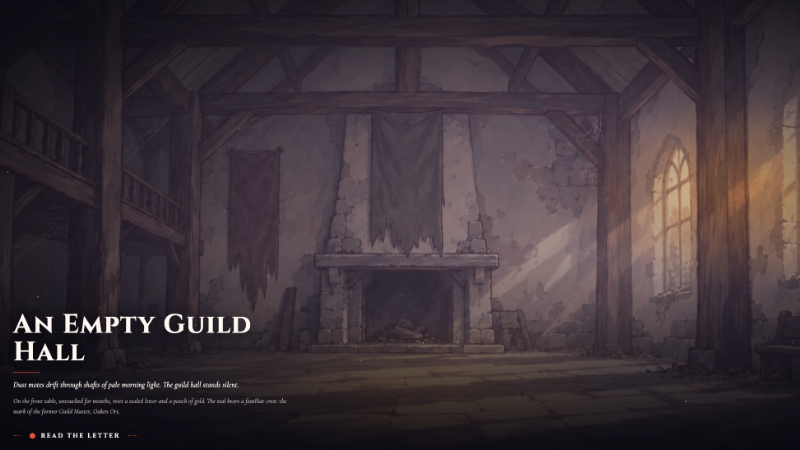
A new game opens on a seven-beat cinematic: the epigraph, the empty hall Oaken Ort left you, his letter with the real inheritance ledger, the naming of your guild, the Great Sage on Hiltcrest, Chapter One of The Shield of Hiltcrest , and the founding itself. It replaces the three separate overlays that used to stack up before you could play. Founding now drops you onto the frontier map, with a "Ride out to the frontier" button, a pulsing beacon over the region holding your first contract, and a "First Steps" task that points you there, instead of dropping you at the Front Desk. The Sage says a word about the frontier map, so the veiled regions read as land to push into rather than a blank. New custom-difficulty slider "Rival Tower Head Start" (0-100%, default 100%) controls how deep rival guilds have already descended the Tower when a new game begins, from established powerhouses starting as deep as floor 30 down to every rival starting at the entrance alongside you. Every founding feed now tells you how deep the deepest rival already stands, or that the field starts level. The opening letter names the founders your chosen mode actually seeded, so the roster count and the list of who stayed agree.
The Goblin Siege
The World Event: Goblin Siege has received its next round of upgrades. The warband no longer sends three quests to the board. It comes down the roads. NOTE: More is polish is coming here, the key element with this update is to get some of these more complicated multilayer systems working cleanly.
Named hosts spawn in the outer regions and march on Hiltcrest over eight weeks, and you fight them on the War Table. Order a sortie against any host on the map, one party per host and one host per party. A repelled host breaks outright; a hard-fought one breaks after the second grind. A patrol stationed in a region is the picket line. It auto-engages any unbroken host standing there, with no order needed. Every unbroken host is commanded from one muster on the siege's home region panel, sorted by urgency. The goblin emblem and every host stamp on the map open it, scrolled to the host you clicked. A host that reaches the harbor ring strikes the wall when the week turns: a forced alarm, a muster of up to two parties, and a fight at the gate of Hiltcrest. Patrols from the Bridge and the East Ridge fall back to the walls at no rest cost. Lose the gate fight and a building burns. A damaged building contributes nothing to effects, unlocks or synergies until an overseer repairs it, but it keeps its tier: a damaged fortress is still a fortress. Hosts on the road cut supply lines and suppress region threats in the regions they occupy, and a town whose region carries your outpost costs them an extra hop to pass. A fourth wave lands in siege-week 7 that hardens every surviving host without spawning any, so a warband you let fester can reach the tier-4 Goblin Lord at the gate. The Quests tab carries an "Under siege" strip with a Muster CTA, and a red dot sits on the nav tab while the town is besieged.
The Layout Editor
An "Edit Layout" button beside Settings puts the game into an "Edit Mode" and the many tabs and panels now are under your control. Drag panels within and across columns, reorder and collapse and resize columns, resize scrolling panels, hide and restore panels, reorder and resize table columns, and reorder or hide nav tabs. The Front Desk, Treasury, Guild Hall, the Faction page, Markets and the roster table are all editable, with per-screen and global reset. NOTE: This is step one of many, so let me know how it feels. Not all features are editable just yet, this is a big infrastructure project, so I'll be taking small steps. Panels can be popped out into their own window, and the battle arena can move to a second monitor. Once popped out, every following battle opens there, an idle plate shows between fights, and it reopens on your next launch. NOTE: Sometimes Steam is a little weird this, so let me know how it goes. Your layout is stored on the device, never in the save file, and a player who never opens the editor sees exactly the old screen.
The Crown Cup League
The Lists
Sim or Watch your own bracket match and a box score opens: every fighter's damage, damage taken, healing and knockouts, an MVP badge, a wounded mark, and a damage-share bar, the same columns your quest and tower reports use. Best-of-three ties carry a scoreboard: one pip per leg above the bracket, filled leg by leg as you watch, and again on the box score when the tie settles. A pop-up three weeks before each festival warns you when you have registered nobody, tells you exactly which week the rolls seal, and takes you to the Registry. It can be turned off in Settings ▸ Gameplay. Missing the Roster Seal no longer means missing the festival. The Registry and the rules screen say plainly that an unnamed roster auto-fills and your guild still competes. You simply do not choose who fights. If you would rather sit one out, the reminder offers to abandon the festival outright: no entry, no placement, no penalty, and a feed line saying so. A sealed squad registry can be reopened for the rest of the week by paying a crown fine: 750 gold two weeks out, 1,500 gold one week out, 3,000 gold on fight week. The seal reapplies when the week ticks over, so staying open costs another, steeper fine. The fine is refused once the bracket is drawn, since the fight already reads the squad as it stood at the draw. Single-player only.
Your proving year
The first (proving) year's tab reads more clearly now. Brackets says "your proving year is for watching; you compete from Year 2" and the Season screen shows a "Format Rules" button in place of a dead, unexplained greyed-out "Register Party". New custom-difficulty toggle "Compete From Year 1" seats your guild in a division from Year 1 and runs the whole seasonal calendar immediately, instead of spending your first year as a spectator (default off). Added to help multiplayer games dive straight into the CCL.
Multiplayer
A host can switch the four seasonal festivals on for a league already in progress, co-op leagues included, and a league running without them now says so on the Crown Cup page instead of falling back silently. Co-op and events-off leagues no longer show a full tournament calendar with a greyed-out "Register Party" button for tournaments the league can never play. They show the standard Crown Cup landing instead.
Command & Correspondence
Faction request and offer letters now carry a reply window, twelve weeks by default, with a countdown in the inbox and a red warning the week before it closes. Let one lapse and it locks, and silence costs half of what an outright refusal would have. Your Guild Commander writes as soon as unrest crosses into insubordination, a full stage before the resignation threat, and names the one thing driving it. You can hear them out, promise a lineup change, or back the call, each with its own price. The Commander's weekly briefing pulls their recommendation out of the flavor quote into a distinct "Commander's Ask" line, with a link straight to the Ledger. Auto-filling a party the Commander has an open recommendation for now applies their suggested bench/field swap first, credited as advice followed, before topping up the empty slots.
Roster, Recruitment & Parties
The Recruitment office gains a "Trading Block" sub-tab listing the rival adventurers actually put up for sale: asking prices, scouting, favorites, and buyout/swap offers, split out from the full-roster "Guild Block" view. Swap two entire party lineups in one action, including between expedition and training parties, or trade a single member between parties in one gesture. Both work by picker or drag-and-drop, and auto-training enrollment is re-derived for each party's own window after the swap. The party member-swap picker has search, role filters and sorting instead of one long unfiltered list. The Sets tab has an explicit "Equip all · +N" per hero over a searchable, roster-wide list. Empty slots fill at once; pieces blocked by worn gear open a confirmed swap that names what comes off, so the hero ends up with the whole set and its set effect. The Sets screen's COMPLETE badge names the hero wearing the full set, and Set Commission quests on the board show how many pieces the named hero currently wears ("3/4 Divine Light"), so a completed set and an open commission for a second copy no longer read as a contradiction. Instructors can take the paid training trip, blocked while they are coaching, drilling or seated on the Academy faculty. An instructor away on a trip is dropped from the training pickers rather than silently voiding an enrollment. A watch scout that runs out of targets names why it went idle ("N recruits hidden by the 'Hireable only' filter", "all eligible recruits scouted"), and a scout whose narrow scope empties drops to the next priority rung the same week instead of sitting idle for one. Set a potential tier and any completed scouting report at or above it is flagged in the Live Feed.
Markets, Trade & Treasury
Set a standing target stock per material and restock everything short in one click. The plan buys only what the market has and what your warehouse has room for, and walks your gold in order so you can see which lines you can afford. Standing restock lists carry a per-material max price per unit and a High / Normal / Low funding priority, and a list surface shows every material you have a target for with why it did or didn't buy this week: stocked, out of stock, warehouse full, or priced out by your ceiling. "Restock all" now stops before the AMM bulk premium by default instead of spilling into it, and names the trim on the toolbar. The Portfolio's "even into the bulk premium" toggle turns it back off. The Guilds list and the Portfolio demand panel show what each guild pays per unit, so finding a fair buyer is a sort instead of a tour of thirty-one guilds. The Treasury header carries a financial overview: weekly net and runway, at a glance. The Regional outpost card buys materials per-material, or every affordable missing one in a click. The trade ledger's single "Value" sort splits into Best deal (market-value ratio) and Most gold (net gold gained), on both the All Offers ledger and each guild's incoming list. Every incoming material row shows its deal-quality badge and its net gold, and material trade cards show a net figure beside the in/out split. The trade builder no longer jumps under your cursor. Both valuation rows show from the moment you open a trade, reading "Select items" until it's valid, and the auto-balance control has a permanent home in the offer header, greyed with a reason when there's nothing to balance. Materials with an export floor set show a "keep ≥ N" badge in the trade builder, where you build trades.
Crafting & Construction
The Workshop's craft-quality bar says "Quality" on every letter it prints, so it stops reading as a contradiction of the potential badge above it, and it draws the crafter's talent ceiling: bands beyond reach are dimmed, with a marker at the skill seminars can carry them to. The Estimated Sale Price forecast is the true expected value across the roll, not a floored point estimate that could misstate a basic recipe by nearly double. The shoddy-repair panel gained the buy-missing shortcut the rest of the build surfaces already had, with a per-material Buy button and a "Buy all missing" line. The tier-upgrade and station breakdowns gained the same one-click shortcut. Construction gained an optional one-click "Auto-assign & Build" path that staffs the project and starts it. The construction quality forecast reflects the crew you actually assigned and your Construction Yard bonus. It previously read from the overseer's skill alone, so the projection never moved no matter who you staffed. Salvage is easier to find: a visible hint at the per-item Salvage button when you have no Blacksmith or Armorer hired, and a "Salvage gear" button in the gear grid that deep-links to the bulk panel. The Shoddy construction outcome is re-named as a Low-Quality build throughout, and the repair panel states plainly that your Overseer handles a repair alone, with no crew needed. The Crafting panel opens with a line explaining that crafting turns materials into gear while guild buildings unlock and upgrade the stations.
Battles & the Board
The Hex Battle System now has a 1.5× playback speed. Click a fighter in the initiative strip who has already acted and playback rewinds to their last turn. Overall ratings on the placement board are bigger and colored by strength: gold at 75 and above, green from 60, the usual bone through the middle, dim below 45, so you can find your strongest tanks for the front line at a glance instead of reading every token. Identical enemy clones collapse into one row on the damage rail ("Marauder ×10") instead of ten copy-paste lines. The number is that unit's total, and hovering says so. The red enrage wash that floods the arena once a match passes its enrage round is now actually visible. It was measurably invisible at its old strength. Upgrade advice can be filtered by crafter. Pick one and the panel switches to that crafter's full list of buildable upgrades, including the ones a spare item or another profession was quietly beating. Heroes out on a quest or raid now appear in upgrade advice, so you can plan what to build for them while they're away, with the equip row shown but disabled and its reason given. A guild name on the tournament bracket opens that guild's profile, like everywhere else in the tab, and the Registration screen's Backups strip has its own two-click Clear, so emptying a fifteen-deep backup list is two clicks, not fifteen.
Portraits & Presentation
Twenty-three faction characters have new portraits. Feature portraits are larger: the dossier header and registry panel at 120px, the party lineup slot at 80px, and every portrait you click opens a card with a full-width portrait banner. A Portrait Size preference under Settings ▸ Display scales those feature portraits to Large (1.25x) or Huge (1.5x) without touching dense list rows. NOTE: New art is trickling it, but it will continue to be slow. I'll update finished assets when I have them.
Desktop, Linux & Privacy
The native Linux build launches on stock Ubuntu 24.04 and on distributions that restrict user namespaces. Every Linux startup fix the game carries now actually reaches the command line, through the Steam depot and the AppImage alike, and the .deb install launches from the command line as well as the desktop entry. Desktop builds move to a much newer browser engine, which is what addresses the "slideshow that no setting could fix" on recent NVIDIA drivers. On macOS the game no longer randomly asks for microphone access over the main menu. The sound system is built on your first click now, and with sound effects turned off it is never built at all. Force GPU Acceleration is a new switch for boxes whose graphics driver is on the engine's blocklist, so filter-heavy views stop rasterising on the CPU. It works on native Linux and under Proton, and turns itself back off if the game then fails to open. Display Backend: the old Force X11 switch becomes a three-way choice, automatic, force X11/XWayland, or native Wayland. Launch Diagnostics is a card in Settings ▸ Display that copies a one-paste report of your display server, graphics driver, whether the game got GPU acceleration, and any launch errors. It strips your operating-system username and masks home folder paths before you copy, and it now records whether Steam initialised, which makes a silent cloud-save or achievement failure one paste away. A pop-out window can no longer be opened by a remote page and inherit the app's save and Steam bridges. The Twitch sign-in window carries its own block as well. The hardware-acceleration toggle now says what it can and cannot do: it turns acceleration off, it cannot turn your GPU on.
Balance
The Party of Heroes commission is an occasion, not a standing order. It no longer posts a duplicate while one is away in the field, it waits 26 weeks after a success, and each one you complete raises its gold and renown by 15%, to a cap of +75%, drawing a different title each time. Epic and Legendary heavy armor (Plate, Mail) now require Strength to wear, and Epic and Legendary arcane focuses (Staff, Tome, Circlet) now require Intellect. Everything below Epic stays universally wearable, and gear already worn stays equipped. A crafted item's rarity now reflects its actual per-stat power rather than the craft-quality tier, and with it its color, sell price and enchant ceiling, so a low-recipe high-quality craft no longer displays or sells as a false Legendary. Reforging follows the same rule. Nine master-tier legendary recipes now unlock at Tower Floor 75 and 80 instead of 90 and 95, so the gear arrives with tower left to use it on. Dragonscale Armor and Crown of Stars stay at 85 as the deepest craftables. The War College takes a protégé at least 5 levels below the chosen mentor, replacing the flat level-8 cap that left the feature with no eligible students by the time it unlocked. Every hero you field in a festival match gains +2 morale, win or lose. Being chosen for the lists is felt. Winners still take the larger +5 surge on top, and the fielded side that takes a festival earns the Festival Champion badge, a permanent record trait with no stat effect. It's just nice to be recognized. The Shining Star who arrives at the Observatory is now actually as S-Tier: their per-category potentials, growth ceilings and starting stats all roll at S-Tier instead of the headline claiming a rank the badges contradicted. Existing Shining Stars are repaired on load, keeping earned stats; only the growth ceilings are regenerated. The Floor 40 Gathering letters no longer promise a fixed six-month countdown. The threat still accelerates, but no deadline is quoted that the descent does not actually keep.
Bug Fixes
Academy & prospects
The Academy reconciles a trainee's potential tier at every semester boundary instead of only at graduation, so a promotion earned early pays for the training weeks that follow it rather than arriving after them. Youth prospects' seven category potentials are budgeted against their headline tier, so a C-Tier prospect can no longer show six B-Tier attribute groups, and no longer trains under a growth cap meant for a lesser talent. Academy trainees keep their per-category spread. Every stat was converging on one flat number, so a trainee graded S in Vitality and Arcane trained to the same ceiling as their dump stats. Prospects and trainees no longer show directly-opposed descriptors on the same dossier. A hero can no longer roll both Determined and Lazy, or Focused alongside Lazy or Easily Distracted.
Combat, Tower & reports
The Tower muster's death forecast quotes what the fight actually does now. There was a bug that was composing a model the hex descent stopped using and dividing by mitigations the descent never applied, so a party could read a 2% death chance and bury fourteen. The Party Combat Stats chemistry chip read from a band table that disagreed with every chemistry tier, showing a Harmonious party at −4%. The chip and the Teamwork and Chemistry rows now render the shape the engine applies. On higher Injury Rate settings the wear-and-tear roll now weighs each raider by how much health they actually lost, so a hero who ended a clean victory at full health can no longer turn up in the injury list while the one who bled walks away clean. The Deploy button can no longer be pushed off-screen. The teammate-variety advice starts collapsed behind a one-line summary, the deploy panel scrolls when it runs tall, and Deploy stays pinned to the bottom of it. The garrison skirmish report groups defenders by the party that stood the watch, so…
This announcement was originally published by The Math Team on Steam on Sep 17, 2026.
Open the original on Steam